
Project Description
The Irish language is a topical subject in the present day context of Northern Ireland. In some
circles it has been politicised, used to serve the ends of a political aspiration. Using a language for a political agenda however, only does a disservice to that language and ultimately marginalises it. A language is not the possession of any particular political ideology – it is first and foremost a means of communication.
History demonstrates that during the first half of Ireland’s inclusion in the union with Great Britain, from 1801, the Irish language prospered. Before the devastating famine, Ireland had a population of eight million, half of whom were native Irish speakers. Some of the leading advocates for the language were Protestants in general, and Presbyterians in particular.
The renowned Presbyterian leader at that time was Dr Henry Cooke, himself an Irish speaker who promoted the language and established three hundred Irish speaking schools from north to south accommodating 16,000 children “who speak exclusively or generally in the native Irish tongue”. Dr. Cooke also persuaded the Synod of Ulster to place a requirement upon students for the presbyterian ministry to learn and be examined in the Irish language, so they could effectively evangelise their own countrymen.
Dr. Cooke did not view the language from a political perspective, but as a means of communication to assist in the church’s mission of evangelising people with the gospel of redeeming grace. In 1836 he addressed the General Assembly of the Church of Scotland. His speech was sprinkled with Irish words and phrases appealing to Scottish Gaelic speaking preachers to come to Ireland. “The earse” he said, “of your Highlands is so nearly akin to the Gaeilge of Ireland, that a few months would enable many of your preachers to proclaim the gospel to our countrymen. We will receive you into the heart of our humble hospitality, brotherly kindness, and gratitude and the cead mile fault romhat (hundred thousand welcomes) with which Ireland will meet you; will flow as warm from her heart as from the spirits of your Highland clansmen.”
Henry Cooke and his companions exhibited the vision and approach of reformers and puritans who preceded them. The father of English puritanism, William Tyndale is one example. He had a burning desire to place in the hands of Englishmen, the Word of God in their own language. Until that time the Bible was forbidden in English, locked up in Latin, a language the majority of common people did not understand.
Tyndale opposed that tradition, stood up to the authorities of his time, acted against bishop and king, and proceeded to translate the Bible into the English language. He manifested the puritan spirit, a spirit that placed greater consideration and priority upon God’s authority than man’s. Subsequent history confirms that it was the Bible in the language of the common people that caused the reformation to become so influential in England.
The same spirit was witnessed in Ireland, but the circumstances were much more complex. The church in Ireland followed the same model as the church in England. At the time of the Reformation during Henry VIII’s reign, the Irish church changed from Papal authority to English prelacy having the English King as its supreme governor. But the Irish church found itself in a very different situation to that of the English church. England proved to be the origin of the puritan movement, but Ireland became in essence, its first mission-field.
Crawford Gribben in his informative book “The Irish Puritans” outlines the diverse nature of Ireland’s population at the turn of the 17th century. The population was 1.4 million and within fifty years would grow to 2.1 million. He identifies three main groups within those figures:
- The native Irish whose ancestry and Celtic origin travelled back thousands of years. Their culture was Gaelic and their religion intertwined pagan practice with medieval Catholicism.
- The ‘Old English’ had descended from English colonists who had moved to Ireland during the 11th -16th centuries. Their colonisation caused intense conflict but in time they assimilated with the native Irish abandoning English culture and language.
- The ‘New English’ were much more recent settlers who had arrived during the 16th century.
They were generally Protestant and in support of the English throne. The flight of the Irish Earls in 1607 and the subsequent forfeiture of their lands opened the way for further plantation of English and Scottish settlers especially in the north of the country.
The policy of plantation both in the 16th and 17th centuries led to major tensions within the kingdom. The New English recognised their hope of advancement depended on replacing the Old English and thus bitter rivalry ensued. Into this melting pot was thrown the church but sadly it was used as a tool of the English crown to further its aim of colonisation, or the implementation of its policy to civilise the Irish, essentially the establishment of English culture.
It is in that setting that the outworking of the Puritan conscience appears plainly, especially in relation to the evangelisation of the Irish, and particularly in their own language. Following Elizabeth’s coronation, the 1560 Act of Uniformity required church services to be conducted in English or Latin. The government discouraged the use of the native Irish language and a law dating back to Henry VIII required Irish people to learn English. The inclusion of a Latin alternative was intended to solve a dilemma in Ireland at that time. The vast majority of ministers in the Church of Ireland did not speak English, nor did their congregations, hence the inclusion of Latin to facilitate the Irish predicament. It was an inadequate solution, for whether services were conducted in English or Latin, the common people understood neither. Many were illiterate and could not read reformed literature. Puritan ministers saw this as a significant impediment to the progress of the Reformation, and a denial of the very principle demonstrated in England, namely the communication of the gospel and evangelisation of the people in their common language. The Church of Ireland attempted to evangelise the native people in either English or Latin, both of which were foreign languages people did not understand. Consequently, by the turn of the 17th century the Reformation had made very little progress in Ireland.
The lack of progress, along with the resurgence of the influence of Romanism through its counter reformation in the later years of the 16th century, demanded the adoption of a different approach. Trinity College was established in Dublin in 1592 and became a centre of Puritan teaching and training for the Irish church out of which the Puritan missionary vision for Ireland was developed. One of the main architects of this vision was an unlikely candidate by the name of William Bedell.
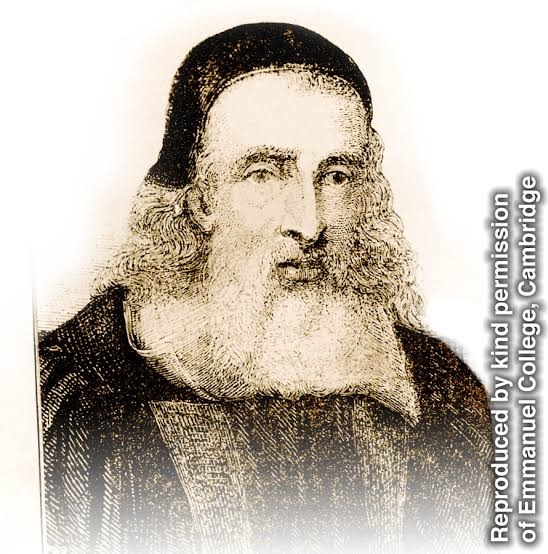
An Englishman by birth, Bedell had been trained in the Puritan atmosphere of Emmanuel College, Cambridge. On the recommendation of Archbishop James Ussher, known for his friendly disposition to persecuted Presbyterians from Scotland, Bedell was appointed by King Charles I as Provost of the Dublin College in 1627.
In many ways Bedell can be likened to William Tyndale. He recognised the failure of the government’s policy of ‘civilising’ the natives. He believed the first priority was evangelisation and to do this, communication was essential. The people must understand what was being preached and the best way to achieve it was to preach to them in their own language.
Bedell manifested the puritan spirit by showing a readiness not to let man-made laws stand in the way of the heavenly mandate. He encouraged the students in College to learn Irish and introduced a grant for doing so. He encouraged Protestant ministers to preach to their congregations in the common language of the people.
His greatest work and legacy was overseeing the translation of the Old Testament scriptures into the Irish language. A copy of the New Testament had already been produced in 1603. Bedell longed to have the whole Bible available in the language of the people. His work was eventually completed in 1638 four years before his death. A further fifty years passed before the first complete Irish translation of the Bible was published, in the year of 1690. The first complete Irish Bible, often referred to as Bedell’s Bible, gained a prominent place in Ireland for the next 150 years, and also among the Gaelic speaking people of Scotland.
Bedell’s actions made him enemies on all sides. He faced opposition from within the church, from those who thought upholding the policy of the English throne was more important. They accused him of disloyalty to the crown. His defence was, “that those people among whom he ministered had souls which ought not to be neglected till they would learn English.” He often quoted Paul’s words to the ministers under his charge, “in the church I had rather speak five words with my understanding, that by my voice I might teach others also, than ten thousand words in an unknown tongue” (1 Cor.14:9).
Bedell’s approach earned him no small measure of respect among the native Irish in his parish of Kilmore, Co. Cavan, where he was appointed Bishop. He was looked upon as the best of the English, a man who acted fairly towards all, and above all with love for the souls of men and women the Lord had called him to serve.
Bedell’s esteem among local people brought him under the observation of Irish rebels and when their rebellion took place in 1641, the Bishop was eventually imprisoned. He was released on the basis of a prisoner exchange but died a short time later due to illness not helped by his recent sufferings.
What William Tyndale did for Englishmen, William Bedell did for the men and women of his adopted Ireland. His approach is considered as the standard for evangelistic missionary endeavour today, but in his day it was visionary, the outworking of a puritan conscience, desiring to proclaim the gospel to every person, and prepared to incur adverse consequences in order to do God’s will.
Bedell’s evangelistic approach was adopted by Presbyterians. In the same year he died, 1642, Presbyterianism was established in the north of Ireland. Five years later the first Irish speaking Presbyterian minister was ordained in the village of Bushmills.
The English crown thought the advancement of English culture was more important than the clear communication of the gospel. Men like Tyndale, Bedell and Cooke did not that share that opinion. Their priority was giving the people God’s Word in their own language. They did not fear the Irish language; they used it for the advancement of the gospel. Evangelicals today ought to follow their example with a confidence drawn from scripture itself, knowing that there will be “a great multitude, which no man could number, of all nations, and kindreds, and people, and tongues” who will cry with a loud voice “Salvation to our God which sitteth upon the throne, and unto the Lamb” (Rev 7:9-10).
The recognition in law of Bedell’s Irish Bible of 1690 would not only be a fitting tribute to his legacy, it would be a worthy acknowledgement of the greatest gift to Irish speaking people ⏤the greatest Irish publication of all time!
NOEL HUGHES